AI search
How to Show Up in ChatGPT and Google AI Answers
The short answer
To show up in ChatGPT and Google's AI answers, keep doing ordinary SEO, open every section with a direct answer, back claims with sourced numbers, and add structured data that matches the page. Then check it by asking the models directly and reading Search Console's generative AI report.
Why ranking first is no longer enough
When Google shows an AI summary, people rarely click through. Pew Research tracked real browsing in March 2025 and found that users clicked a link inside the AI summary on just 1% of visits.
The summary also takes up the screen. In Botify and DemandSphere's late 2024 study, an AI Overview and a featured snippet appearing together filled 67.1% of the desktop screen. A number one ranking can sit below the fold.
Publishers feel it. Penske Media, which owns Rolling Stone and Variety, said in its lawsuit against Google that by early 2025 about 20% of searches returning its sites also showed an AI Overview.
And it is not only Google. ChatGPT has more than 1 billion weekly users, and Semrush ranked chatgpt.com fourth among the world's most visited websites in August 2026. Back in 2024, Gartner forecast that traditional search volume would fall 25% by 2026. That was a prediction, not a measurement, but the direction is plain.
Ranking still matters. Being the source an answer is built from now matters more.
First, what "ChatGPT Astra SEO" actually means
You may have seen tactics sold as "ChatGPT Astra SEO". There is no search product with that name. Two different things share the word:
- GPT-6 Astra is a model OpenAI released on 3 September 2026. It runs inside ChatGPT. It is a model, not a place you can rank.
- Project Astra belongs to Google DeepMind. Google brought its live camera and voice features into AI Mode as Search Live.
What you are really optimizing for is two surfaces. One is ChatGPT search, which reached every logged-in user in December 2024. The other is Google's AI Mode and its AI Overviews, which are available in more than 200 countries and territories. The steps below work for both.
Step 1: Keep doing ordinary SEO
Google is blunt about this. Its own guide says optimizing for generative AI search "is optimizing for the search experience, and thus still SEO".
The basics still decide whether you are in the running: pages that load, that crawlers can reach, and that answer a real question better than the alternatives.
The two kinds of result overlap. SE Ranking found that when a featured snippet and an AI Overview appear on the same US results page, the snippet's page is one of the Overview's sources 66% of the time.
If your pages do not rank, fix that before anything else in this article.
Step 2: Answer the question in the first sentence of every section
AI answers are stitched together from passages, not whole pages. The passage that gets lifted is the one that answers the question most directly.
So write every section so it works on its own:
- Open with the answer. The first sentence after a heading should answer the question the heading asks.
- Make headings specific. "How long a refund takes" beats "Refunds".
- Keep paragraphs short. One idea each, so a passage can be quoted without dragging three others along.
- Use numbered lists for steps. A process written as steps tends to be repeated as steps.
Every article on this site opens with a short answer box for exactly this reason.
Step 3: Back your claims with numbers, quotes and sources
The best evidence comes from researchers at Princeton and IIT Delhi, whose GEO study was published at KDD 2024. GEO stands for generative engine optimization. They rewrote pages in different ways and measured how visible each version became inside AI-generated answers.
- Citing sources, adding quotations and adding statistics worked best, improving visibility by 30 to 40% in their main test.
- In a follow-up test on Perplexity, adding quotations lifted visibility by 22% on one measure, and adding statistics by 37% on another.
- Keyword stuffing did 10% worse than leaving the page alone.
In practice: replace "most customers" with the actual number, name who said it, and link to where they said it.
Step 4: Add structured data that matches the page
Structured data is code that tells machines what a page is: an article, a product, a person, a set of questions and answers. The shared vocabulary for it, Schema.org, was started in 2011 by Google, Bing and Yahoo, and it is still being updated.
Start with these types:
- Organization or Person on your home or about page, so your name ties to one clear identity.
- Article on every post, with the author and the real publish and update dates.
- FAQPage where the page genuinely has questions and answers.
- Product on product pages, with price and availability.
Write it as JSON-LD, a separate block of code, rather than threading it through your HTML. Then avoid the mistakes that get markup ignored:
- Marking up what the reader cannot see. The markup must describe the visible page.
- Leaving out required fields. Each type has some.
- Skipping the check. Run the page through Google's Rich Results Test before you publish.
Step 5: Make it obvious who you are
Search engines keep a map of people, companies and things, and how they connect. Google said in 2020 that its Knowledge Graph held over 500 billion facts about five billion entities. You want to be one clearly defined entry in it, not several blurry ones.
- Use one name everywhere. The same business name, spelling and description on your site, your profiles and any directories.
- Connect your profiles. List your official profiles, such as LinkedIn, in your Organization or Person markup.
- Get named on sites the models already read. In a Semrush study of about 500 marketing topics, Quora and then Reddit were the most cited sites in Google's AI Overviews. For ChatGPT, Reddit and Wikipedia were the two most cited domains. Being mentioned by name in places like these builds the link between your name and your topic.
Step 6: Describe your images and video in words
Google's AI features read more than text. Google Lens handled nearly 20 billion visual searches a month in 2024, and Search Live lets people point a camera and ask a question.
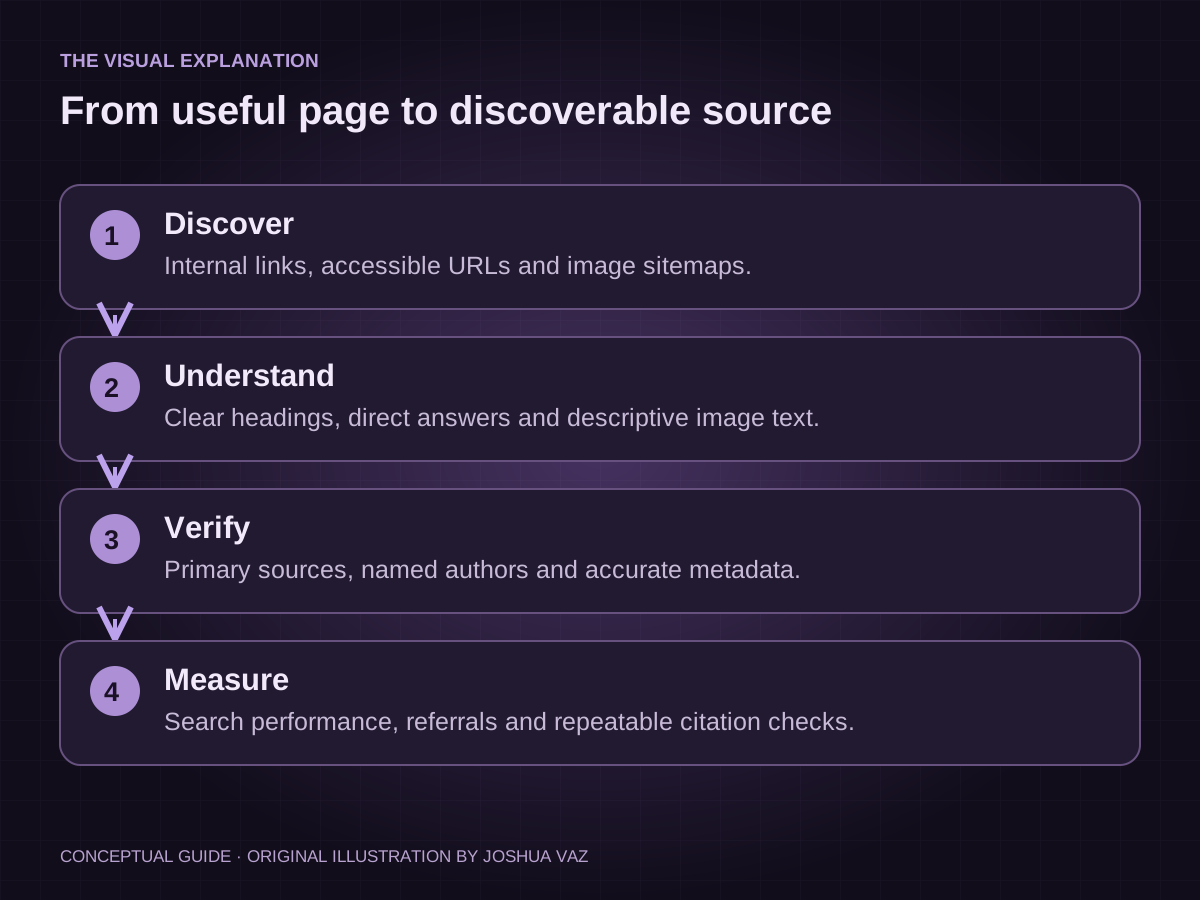
Reading the diagram: Publish important explanations as HTML text, not only inside an image. Use descriptive alt text, nearby captions and crawlable image URLs. Structured data should describe the visible page; there is no special AI schema that guarantees inclusion. Read the source: Google Search Central: Image SEO best practices.
- Write alt text that names things. "Bar chart of monthly AI costs by category" tells a machine far more than "chart".
- Name files like short sentences. ai-bill-by-category.png, not IMG_4412.png.
- Add captions and transcripts. They turn what is said in a video into text a model can work with.
How to tell whether it is working
Rank trackers cannot see AI citations, so measure them directly.
- Read Search Console's generative AI report. Since June 2026, Google has offered a separate view of impressions from AI Overviews and AI Mode, broken down by page, country and device. It reached all sites on 31 August 2026. It reports impressions, not clicks.
- Ask the models. Write down the questions your customers actually ask. Once a month, put them to ChatGPT, Gemini and Perplexity, and record whether you are named and who is named instead.
- Watch AI referrals in your analytics. Visits from chatgpt.com and perplexity.ai show up as referral traffic.
- Use a tracking tool once the list gets long. Semrush's AI Visibility Toolkit, BrightEdge AI Catalyst, Authoritas, Otterly.AI and Profound all track citations across AI assistants.
This site runs step 2 in public. Every month the same ten questions go to ChatGPT, Claude and Perplexity, and the results stay up, starting from a baseline of zero.
A ten-week plan
Start where the effort pays back fastest.
- Weeks 1 and 2: Run your most important pages through the Rich Results Test and fix what it flags.
- Weeks 3 and 4: Add Organization, Article and FAQPage markup to your most visited pages.
- Weeks 5 and 6: Rewrite those pages so each section opens with its answer, and add sourced numbers.
- Weeks 7 and 8: Make your name, description and profile links consistent everywhere they appear.
- Weeks 9 and 10: Add alt text, clear file names, captions and transcripts.
- Every month after that: Ask the models your questions and check Search Console's generative AI report.
If you want it on one page, the AI search visibility checklist covers the eleven things that decide whether a model cites you.
Frequently asked questions
- Is ChatGPT Astra a separate search engine I need to optimize for?
- No. GPT-6 Astra is a model OpenAI released inside ChatGPT on 3 September 2026, and Project Astra is a Google DeepMind project whose live camera features now sit in Google's AI Mode. What you optimize for is ChatGPT search and Google's AI Overviews and AI Mode, whichever model sits behind them.
- Do I need a different strategy for ChatGPT and Google?
- Mostly no. Google says optimizing for its generative AI features is still SEO, and the habits that help, such as clear answers, sourced claims, structured data and being named on sites people trust, help in both. What differs is where you measure the results.
- Which structured data should I add first?
- Organization or Person markup on your home or about page, Article markup on every post, and FAQPage markup where the page genuinely has questions and answers. Write it as JSON-LD and only describe what a reader can actually see on the page.
- How do I check whether ChatGPT mentions my business?
- Ask it. Write down the questions your customers really ask, put them to ChatGPT, Gemini and Perplexity once a month, and record whether you are named and who is named instead. Keep every result, including the months where the answer is no.
- Does keyword stuffing help with AI answers?
- No. In the GEO study published at KDD 2024, keyword stuffing did about 10% worse than leaving the page alone. Adding sources, quotations and statistics did far better.
Sources
- Google Search Central: Image SEO best practices
- Pew Research Center, Google users are less likely to click on links when an AI summary appears
- Botify and DemandSphere, AI Overviews report
- OpenAI, expanding access to AI with ChatGPT ads
- Semrush, top websites
- Gartner, search engine volume will drop 25% by 2026
- Penske Media Corporation v. Google, complaint
- OpenAI, introducing GPT-6 Astra
- Google, AI Mode update
- OpenAI, introducing ChatGPT search
- Google, AI Overviews expansion
- Google Search Central, optimizing for generative AI features
- SE Ranking, AI Overviews 2024 recap
- Aggarwal et al., GEO: Generative Engine Optimization (KDD 2024)
- Schema.org, releases
- Google, about the Knowledge Graph and knowledge panels
- Semrush, AI search and SEO traffic study
- Semrush, most cited domains in AI
- Google, Lens updates, October 2024
- Google Search Central, generative AI performance reports
- Search Console Help, generative AI performance report
Found this useful?
I post the short version of every article on LinkedIn. Connect there, and send me a message if you want to talk about it.
Connect on LinkedIn ↗