For founders
What Jev Changes About Your AI Workflow
The short answer
Jev answers typed questions with confidence scores instead of generating text. For high-volume repeated decisions, like routing a ticket or scoring a lead, published benchmarks report lower latency and cost than the LLMs tested. Use it for the narrow calls and keep your LLM for open-ended reasoning.
The thing worth understanding
Most AI announcements are a bigger version of the thing you already have. This one is a different shape, and the difference is easy to explain without any technical background.
A language model writes. You ask it something, and it produces words, one after another, and your software then has to read those words and work out what they meant. That last step is where a lot of production systems quietly break.
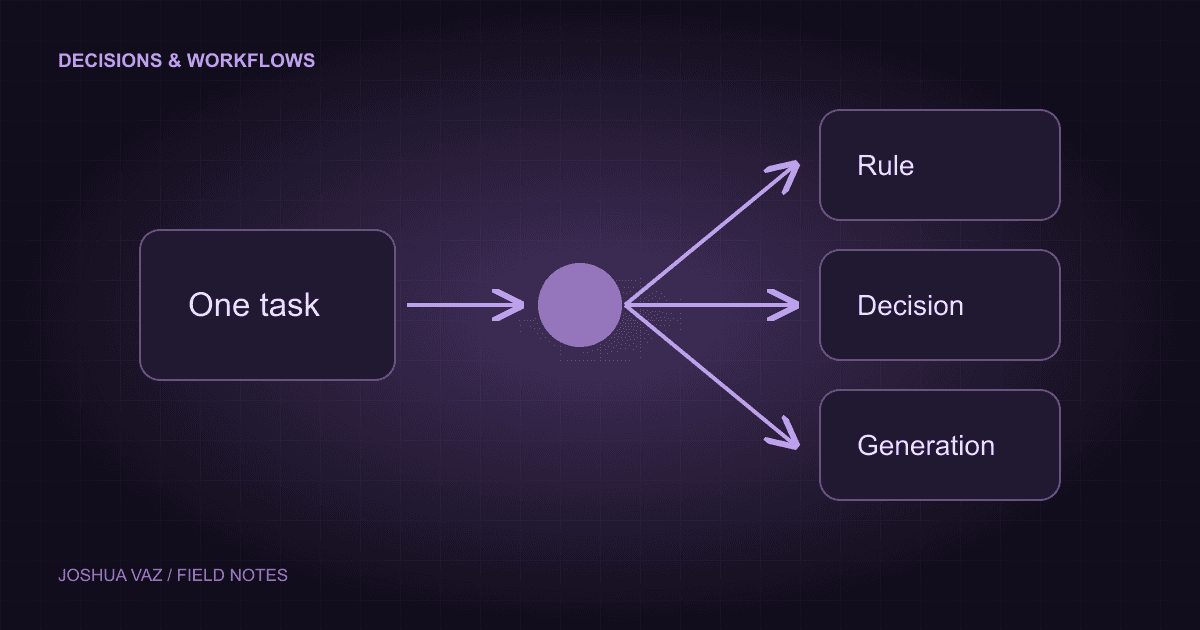
Jev does not write. You hand it some information and a list of questions, and it hands back an answer to each one: yes or no with a probability, or one option from a list you defined, or a position on a scale you set. There is no sentence to interpret.
Mike Taylor, who runs evals at Every, described it as "a smart if-then statement that determines what happens next when you're automating a workflow". That is the clearest framing I have seen, and it is the one to hold on to.
Why anyone is paying attention
TypeSafe AI came out of stealth on 15 September 2026 with a $40 million seed round led by DCVC. Forbes reported a $200 million valuation, citing a person familiar with the deal. The founder, Diogo Almeida, is a former OpenAI researcher who co-invented the training method behind ChatGPT.
Funding is not evidence that something works. Adoption is more interesting. Within 24 hours of launch, Jev was running inside nearly 13% of paid Vercel teams, more than twice the share any previous model launch reached. Developers do not wire something into a production loop that fast unless it solves something they were already annoyed about.
What the numbers actually say
DataCamp ran the same four workflows through Jev and three frontier models. This is the table that matters, because it puts accuracy, cost and speed side by side instead of quoting one in isolation:
| Model | Accuracy | Cost per case | Latency |
|---|---|---|---|
| Jev | 67.8% | $0.0004 | 0.4s |
| GPT-5.6 Terra | 67.9% | $0.0304 | 10.1s |
| GPT-5.6 Sol | 74.1% | $0.0836 | 23.3s |
| Claude Opus 5 | 73.1% | $0.1761 | 37.8s |
Read it honestly. Jev is not the most accurate. Two of the frontier models beat it by five or six points. What it does is match the cheapest frontier model's accuracy at roughly one seventieth of the cost and one twenty-fifth of the latency.
That is the whole trade. DataCamp puts the general range at 40 to 200 times faster and 40 to 400 times cheaper depending on the workload. The published price is $0.042 per million input tokens, with output tokens free.
One more figure is worth more than the cost saving. On structured output, where the model has to return something your code can use without falling over, Jev had a 0% error rate. Claude Opus 5 was at 5.73% and Claude Haiku 4.5 at 45.5%. If you have ever had a pipeline break because a model returned prose where you expected a value, that column is the one to look at.
Where it fits, and where it does not
The pattern is called confidence gating, and it is simpler than it sounds. Act automatically when the model is confident. Escalate to a person, or to a reasoning model, when it is not.
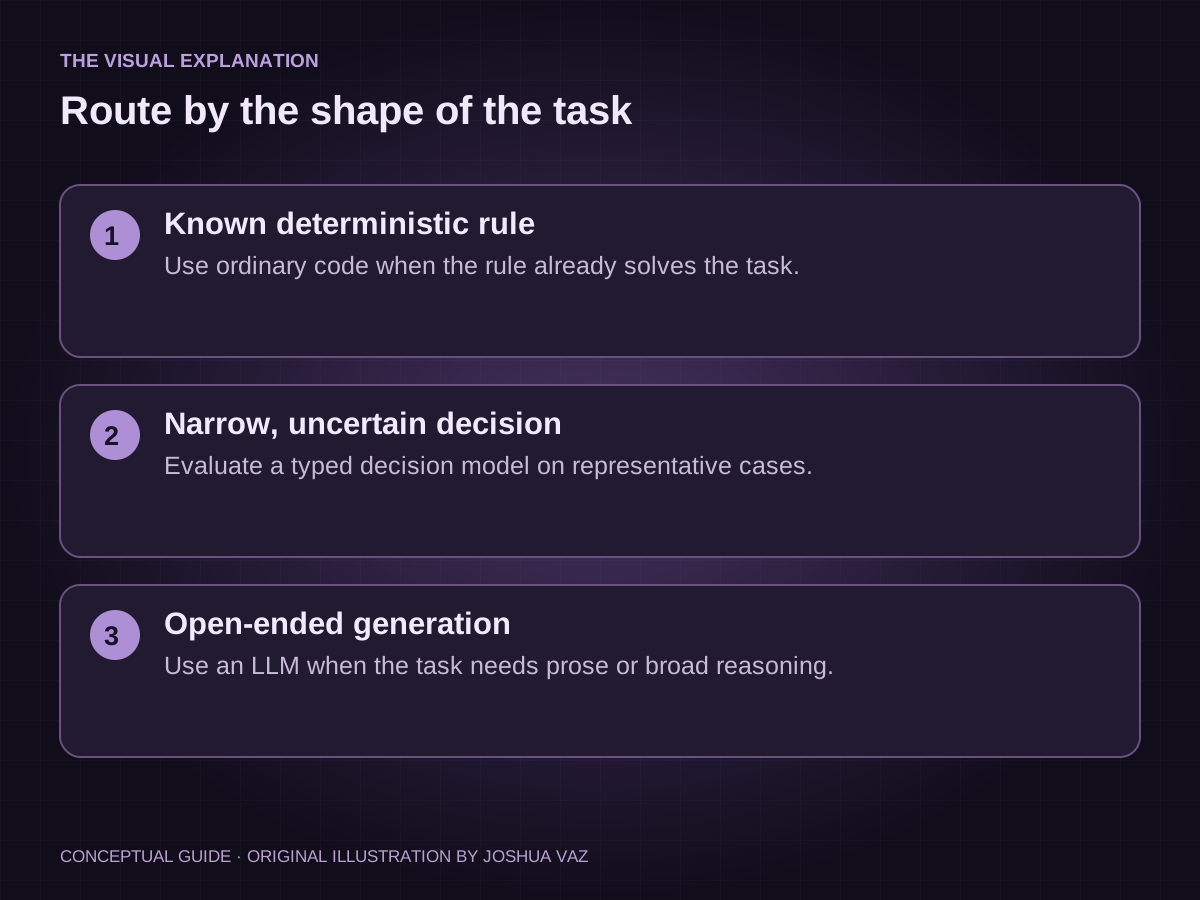
Reading the diagram: Use a deterministic rule where one is sufficient. Consider a typed decision model for a fixed set of possible answers and an LLM for open-ended generation. Test confidence thresholds and route uncertain or consequential cases to an appropriate fallback. Read the source: TypeSafe: Introducing System One Models and Jev.
It fits decisions that are narrow, repeated and high-volume, where you already know the full list of possible answers:
- Is this support ticket urgent, and which queue does it belong in?
- Does this lead match our customer profile?
- Is this piece of content safe to publish automatically?
- Which of these six categories is this document?
It does not fit anything open-ended. Writing a reply, summarising a call, reasoning through a problem with no fixed answer set: that is still language model work, and Jev's own documentation says so.
There is a third case people miss. If a plain rule in your code already handles the decision correctly, keep the rule. A model call costs more than an if statement, no matter how cheap the model is.
This is not a fringe view. A 2026 arXiv preprint argues that using large language models for deterministic, structured enterprise tasks is "inefficient, unreliable, and misaligned" with how that work is actually shaped, and that models should be treated as interfaces rather than as the engine for everything. It is a position paper rather than a settled result, but it names the problem precisely.
What to check before you route real work through it
Jev is in early access. That is not a reason to avoid it, but it does change which questions matter, and they are the same questions I would ask any AI vendor before signing:
- Where does your data go? TypeSafe has not published model weights or a self-hosted option, so your data leaves your infrastructure. Get the retention and training terms in writing rather than from a pricing page.
- What happens when it is wrong? Confidence scores are only useful if something acts on a low one. Decide the escalation path before you turn it on, not after.
- What is the real cost at your volume? The per-call price is tiny. The interesting number is what you spend today on that same decision. If it is negligible, this is a solution looking for a problem.
- What breaks if it goes away? It is a nine-day-old product from a company that was in stealth a fortnight ago. Know what your fallback is.
A sensible first week
You do not need a strategy. You need one decision and seven days.
- Day 1. Get access. It is available through the Vercel AI Gateway and Cloudflare's AI Gateway if you already have an account on either, or by waitlist at typesafe.ai. Run one of the built-in console demos so you can see the shape of the output.
- Days 2 and 3. Pick your single highest-volume repeated decision. Write down what it costs you now, in money or in someone's hours. If you cannot name that number, you are not ready to measure whether this helped.
- Days 4 and 5. Wire it into one path. LangChain supports it inside existing agent loops, and official Python and JavaScript SDKs are available, so this is usually a small change rather than a rebuild.
- Days 6 and 7. Compare the confidence scores against what actually happened. The useful signal is not the accuracy number. It is whether the cases it flagged as uncertain were genuinely the hard ones.
If it works, you have moved a repetitive decision off your LLM bill and cut its latency by an order of magnitude. If it does not, you have spent a week and learned where your decisions are actually fuzzy, which is worth knowing anyway.
The honest summary
Jev is not an upgrade to your language model and it is not going to run your company. It is a cheaper, faster, more predictable way to make the small decisions that were never a good fit for a model that writes essays.
The reason it matters beyond this one product is the direction it points. The assumption for three years has been that one general model should handle everything. This is the first widely adopted argument that the boring, repetitive nine tenths of the work wants a different tool from the interesting one tenth, and the cost difference is large enough that the argument is going to keep being made.
Frequently asked questions
- Does Jev replace our existing LLM?
- No, and the vendor does not claim it does. Jev handles narrow repeated decisions where the possible answers are known in advance. Anything open-ended, anything that has to produce prose, still needs a language model. Most teams add it as a routing layer inside a loop they already have.
- Is it actually cheaper, or is that marketing?
- On the published benchmarks it is genuinely cheaper for the narrow work, by two orders of magnitude. The saving only appears if you were using an LLM for that decision in the first place. If a plain rule in your code already handles it, Jev costs you more than the rule does.
- What is the catch?
- It is early access, launched in September 2026, so there is no long production track record yet. TypeSafe has not published model weights or a self-hosting option, so your data leaves your infrastructure. Confirm the retention and training terms in writing before you send anything sensitive.
- Do I need to be technical to make this decision?
- No. The question is a business one: which decisions does your team or your software make hundreds of times a day, where the answer is always one of a short list? That is the shortlist. Your engineers can tell you in an afternoon whether it fits.
- How do I know if it is worth trying?
- Pick your single highest-volume repeated decision and work out what it costs you now, in LLM spend or in someone's time. If that number is small, skip it. If it is large and the decision is narrow, a one-week pilot will tell you more than any benchmark.
Sources
- TypeSafe AI, Introducing System One Models and Jev
- Business Wire, TypeSafe AI emerges from stealth with $40M in funding
- Forbes, This $200 million startup wants to fix AI's overconfidence problem
- DataCamp, Jev: TypeSafe's System One model
- Startup Fortune, Jev becomes Vercel's fastest adopted launch
- Every, TypeSafe's Jev judged everything I've written in 0.7 seconds
- LangChain, Building a harness with Jev
- arXiv, Position: Avoid Overstretching LLMs for every Enterprise Task
Found this useful?
I post the short version of every article on LinkedIn. Connect there, and send me a message if you want to talk about it.
Connect on LinkedIn ↗